

How To Draw A Bubble Letter P
How to describe chimera letters
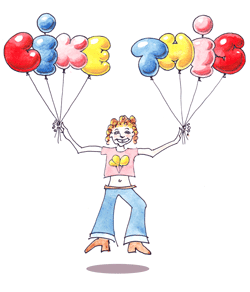
Why does a calligrapher need to know how to depict chimera letters? They're fun. They're easy. You can draw them anywhere with but a pencil, or a biro, and a little colour. They're useful for signs, doodles, cartoons, posters, birthday cards and then along. And they're very unproblematic to decorate.
And so here is the Calligraphy Skills 'How to Draw Chimera Letters' free online tutorial. This is my own alphabet blueprint. It shows how to describe chimera letters based on a circle, so they really BULGE. Information technology's bones, merely it works.
The instructions are not in alphabetical order but proceed more or less from the simpler letters to the more complicated. The images come offset, so notes containing more than information on how to draw the chimera letters. I've as well grouped letters according to similar forms. If you lot start at the beginning and piece of work through, you'll learn the whole Calligraphy Skills bubble alphabet. Or just find any item letters yous desire and merely acquire those.
The society is:
(this page)O Q I ... D B ... C V U ... A H
(folio ii)S Z N ... Eastward M W ... P R F
(page three)Y T ... Grand L 10 ... J G
How to draw bubble messages, step by step
You'll need:
• a pencil – I use a 2H for structure lines and a 3 or 4B for final outer lines, and for shading if I'm shading in pencil
• a adept eraser
• paper
• some kind of color if you lot desire to color the letters in – if and so, make certain your paper is loftier enough quality to have it considering it's frustrating to depict the perfect alphabet on cheap photocopy paper and then find your watercolour paint is running and blotching all over the identify or the chalk pastel won't stick
• compasses (if you are a precise-minded type) to describe the circles, or else something round to draw around or trace ... I began past drawing round a small plastic pot-hat but the reward of using compasses is that the point leaves that footling hole and then you can ever easily find the middle of the circle as a starting-bespeak for constructing the rest of the letter
Ready? :-) Start by lightly cartoon a circle in pencil. This is your 'construction circle'.
It's useful to mark a small dot in the middle of the circumvolve, as a guide while forming many of the letters.
And here nosotros go with O and Q:
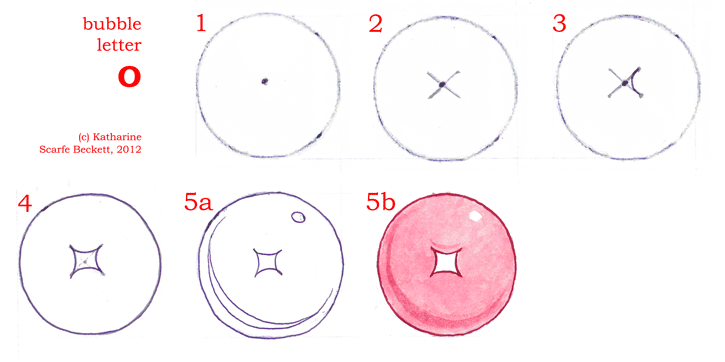
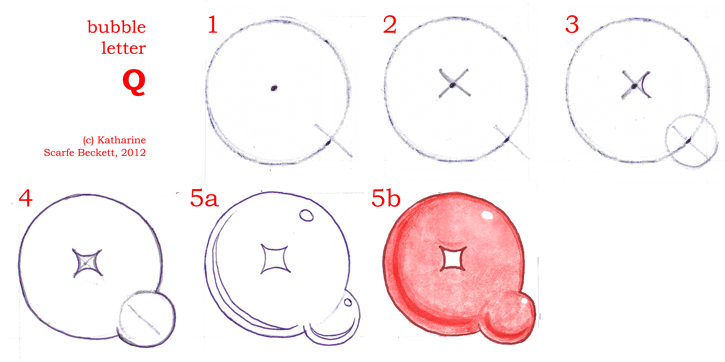
O, Q
Both these are already mostly fatigued for you in the class of the original circumvolve. For both O and Q, find the center of the circle and on it draw a small, regular X. Bring together the points of the Ten with brusk, curved lines bulging inward. That'due south O. Now, for Q, sketch in a small circle towards the bottom correct of the letter (direct reverse the bottom-right betoken of the petty 'star' y'all drew in the middle). It should straddle the outer line of the original construction circle. Erase the inner pencil lines. Black-pencil or ink over the final lines, within and out. You're done. Like shooting fish in a barrel-peasy. Next!
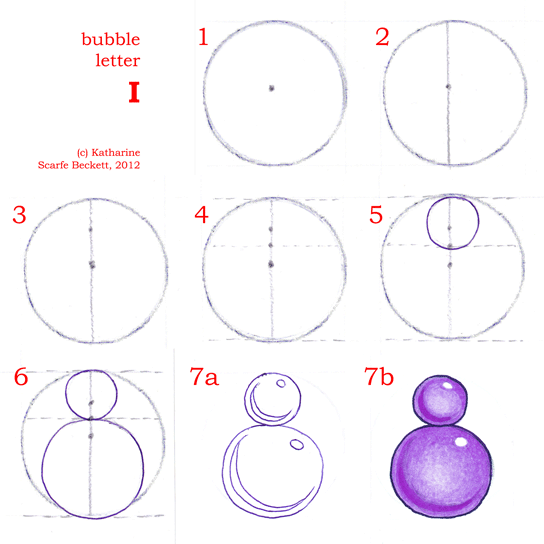
I
I is as well based on the simple circle but information technology's slightly different from O and Q: it's two circles, a large 1 at the bottom which should be about two-thirds the size of your original construction circle, and a 2d littler circle on pinnacle. (I started with a unlike way of drawing 'I' which you tin see in the illustration to a higher place. It worked for a while just eventually I decided information technology looked too fiddly and not bubbly enough, and so I redesigned the letter for this simpler form.)
On to D and B!
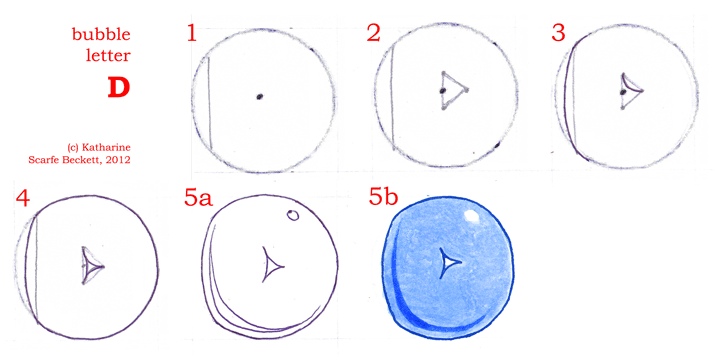
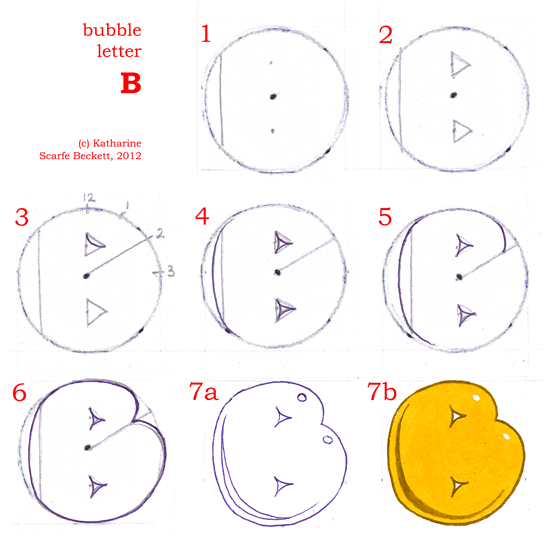
D, B
These two letters have directly backs in most ordinary alphabets. Afterwards thinking for a long time about how to draw bubble letters with long direct lines in them, I decided that the best manner to help the eye recognise the letter is to use a long shallow curve instead. So first draw in the directly back as a vertical line, and then depict a curve that falls exactly halfway between that vertical and the full-round bend of your original structure circle.
Note that the counter or white space inside these two letters is based on a triangle, unlike O and Q which use a four-sided lozenge. This helps the eye sympathize the underlying course of the letter of the alphabet and recognise information technology for easy reading even though it is distorted towards a circle.
The rest of the details (I hope) should be obvious from the illustration. The 'B' is not as complicated as it looks. You could estimate by centre to draw in the curt diagonal line that divides its two lobes. I bear witness a simple way of finding a like position for it repeatedly, in case you lot are drawing multiple 'B'southward in the aforementioned stretch of text. Imagine the circle is a clock-confront, and draw the line from 2 o'clock to the eye.
Set up for C, Five and U? They employ divider-lines in an even more exciting mode than B. If you really want to know how to draw bubble messages, then you're most to learn a very interesting technique ... Oh, the suspense :-)
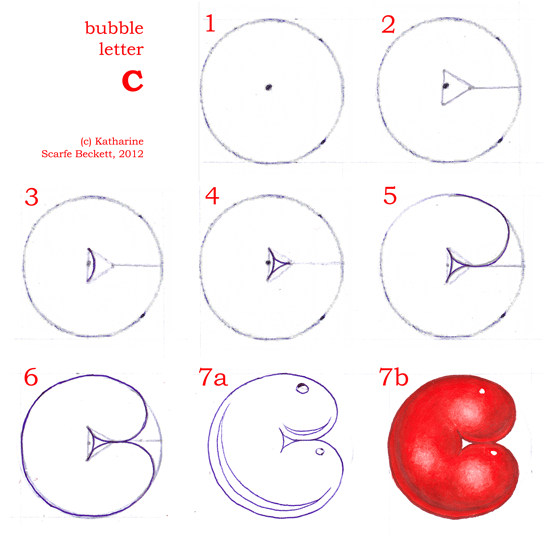
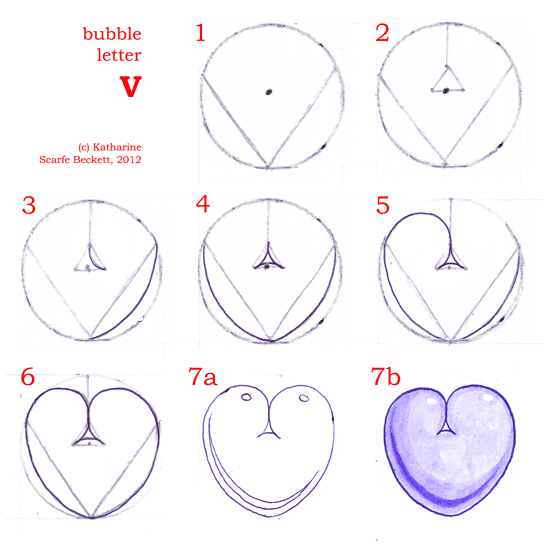
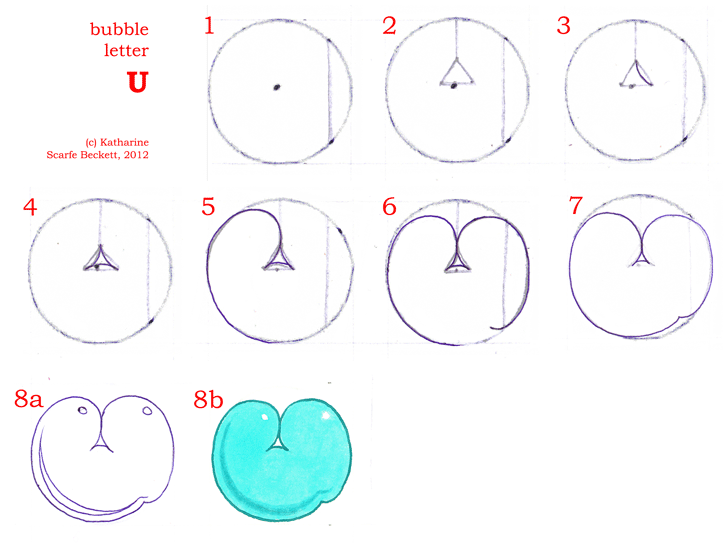
C, Five, U
(By at present you lot will have noticed that my images are dissimilar sizes according to whether at that place are three or four letterforms in the rows. Yep it is accidental. No I have not had time to right them all and re-upload them. It was tardily at nighttime in Photoshop, I was tired, etc etc. Sorry.)
The way the dividing lines piece of work in these messages is important to grasp so that you know how to depict chimera messages that look fully inflated merely not squashed. When you lot depict the curves from the inside triangle, make sure (a) that they extend smoothly into the remainder of the letter and (b) that they merely just bear upon the dividing line at one point. If they run along the dividing-line, they will brand the letter look pressed-together, and a fleck odd. If they don't touch at all, the letter won't look as round and bubbly as it could.
Of course, if y'all want to alter that rule deliberately to create your own effect for a new alphabet, that's different. Go correct ahead!
The C has some ersatz reflected-light highlights added – the paler patches reverse the highlights, on the 'undersides' of the curves. Crude, only I sort of similar information technology.
In theory yous could create but one alphabetic character, a kind of slightly pointy curvy matter with no right-hand 'leg', that would stand for both 'V' and 'U', the fashion the Romans did with awe-inspiring and rustic capitals. I prefer to have two split up messages since this is a modernistic alphabet.
Now for A! And H! Aha!
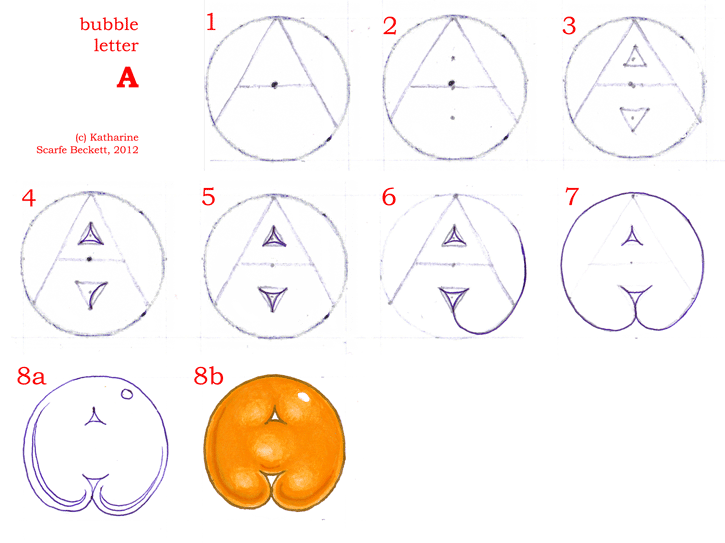
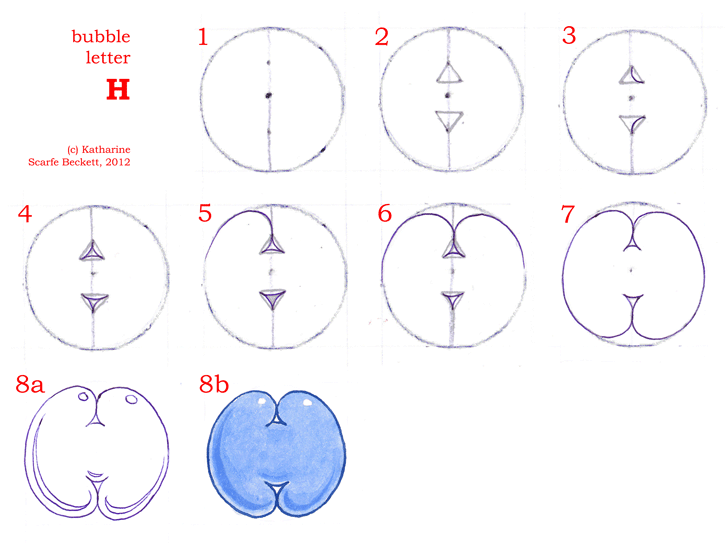
A, H
(More reflected-light highlights on the A. I was having fun.)
These two messages are fairly elementary to work out once you have grasped the bones principle of dividing the circle and cartoon internal curves that merely touch each other. As yous can see, an H is only an A with another dividing line at the elevation.
Based on D and B, you might think it would make sense to employ long, shallow curves to represent the longer straight lines of 'A' and 'H', instead of letting them follow the original fatter curve of the structure circle. However, I recall these two letters remain very recognisable with round sides, and bubblier that mode. Equally it's all nigh how to depict chimera letters, non totally consistent messages, it seems best to keep it elementary.
Side by side up on the 2d page are S Z N ... E M Westward ... P R F.
(Y T ... K 50 X ... J Yard are on the third page.)
A trivial background
I didn't originally intend to write a tutorial on how to depict bubble letters. Nonetheless, I just couldn't observe a free bubble alphabet online that I really liked for the site. 'Bubble' to me ways the letter has to be a round shape, practically spherical. Like a bubble!
And then I started drawing my own letters to show visitors what I meant ... so I noticed some useful rules emerging for how to course similarly-shaped letters ... side by side thing I knew I'd designed my own version of a bubble alphabet and was cartoon trivial step-by-pace instructions for visitors to show them how I'd done it and how they could reproduce it (and redesign it of class).
The concluding forms above are all presented adequately similarly (ie i color per alphabetic character, highlights top right, crescent-shaped shading) and then you tin meet that it's a coherent alphabet. However, I've varied the colours and textures of the shading. Partly that's to help give an idea of how the letters look using different furnishings. Partly it'due south to encourage yous to colour your own the way you want them to look. And it was more fun that manner, too :-)
Designing your ain alphabet is a lot of fun. I recommend it! Feel free to use this page equally you wish for personal and educational purposes, and of course utilise it to inspire your own alphabet designs. Delight don't sell the instructions or images. As their creator I intend for them to be bachelor for no charge.
Go to 'How to Describe Bubble Letters 2' (S Z Northward ... E K W ... P R F)
Go to 'How to Draw Chimera Messages 3' (Y T ... K L X ... J K)
Return to 'Bubble Letters' (general overview, and other links)
Return from 'How to Draw Bubble Letters' to the homepage

Source: https://www.calligraphy-skills.com/how-to-draw-bubble-letters.html
Posted by: baileyrectelon.blogspot.com
0 Response to "How To Draw A Bubble Letter P"
Post a Comment