

What Muscles Does Drawing A Bow Work
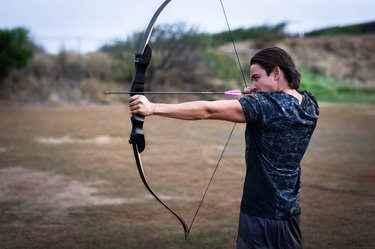
Archery works your shoulders, back, arms, forearms, core and hips. Train for it with these exercises.
Prototype Credit: globalmoments/iStock/GettyImages
Hitting a bullseye involves a lot of skill — and muscles.
Archery requires full-body strength, and works the deltoids, latissimus dorsi, traps, biceps, triceps, forearms, core and hip muscles, according to USA Archery.
Here'due south everything you lot demand to know about the muscles used in archery and how to build them for improve performance.
ane. Shoulders
Shoulder stability is an important gene when training both your bow and draw hand. Your ability to hold your arm and the bow all the same is fundamental to your aim.
Your deltoids and rotator gage muscles are in charge of stabilizing your upper arm bone, the humerus, in your shoulder socket (aka the glenohumeral joint). Wrapping around your shoulder blade, your rotator cuffs include the subscapularis infraspinatus, teres minor and supraspinatus, per a January 2021 StatPearls article.
The best exercises for these archery muscles include scaptions and wall slides.
Scaption
- Stand with a dumbbell in each hand, arms at your sides, palms facing in.
- Brace your core and lift the dumbbells in front end of your torso at nigh a 45-degree angle.
- Raise the weights as far as comfortable or until they're at shoulder height.
- Intermission, so lower the weights back downward with control.
Wall Slide
- Stand with your back flat against a wall and sink downwardly into a slight squat.
- Place your arms and elbows against the wall in a goalpost position, bending your elbows at a 90-degree angle. The dorsum of your hands should bear upon the wall.
- Keeping your back confronting the wall and not arching through your lower back, slide your hands up as far equally you can overhead.t
- Interruption, and then return to the starting position.
ii. Back and Biceps
The latissimus dorsi is the largest muscle in your dorsum and is i of the main archery muscles involved in cartoon. Using your traps, especially your lower traps, may significantly ameliorate performance, according to the December 2018 study in the Periodical of Sports Medicine and Physical Therapy. Your rhomboids, other upper-back muscles and biceps besides help.
Spending fourth dimension on a rowing car tin assistance you build endurance through your lats, traps and biceps. Meanwhile, y'all can load the lat pulldown and lat pullover exercises a bit heavier to train your maximal strength.
Try adding isometric pauses to your back and biceps exercises. Your need to be able hold your arrow at full draw.
Lat Pulldown
- Sit at a lat pulldown machine. Place your anxiety flat on the flooring and grab the attached bar with your hands just farther than shoulder-width apart, palms facing away from you lot. Caryatid your core.
- Squeeze your shoulder blades down and together as tight as possible then pull your elbows to your sides to lower the bar to your collarbones.
- Pause, then slowly extend your artillery dorsum to the starting position.
Lat Pullover
- Lie face-up on a bench with your feet apartment on the floor. Hold a brusk barbell, EZ bar or dumbbell with both hands direct up over your chest.
- Keeping your arms straight, lower the weight back behind you lot as far equally comfortable and without arching your lower back.
- Suspension, and then raise the weight back to start, still keeping your artillery straight.
3. Triceps
It is of import to train the muscles responsible for the majority of the movements a sport requires. However, it is besides important to train the combative muscles for each movement, co-ordinate to the American Council on Exercise. For case, cartoon the bow involves the biceps. To preclude overuse injuries, you lot should also railroad train the triceps.
Bonus: your triceps are what keeps your front arm and elbow straight at full draw. So when doing exercises similar triceps kickbacks, add a short hold to each extension.
Triceps Kickbacks
- With a dumbbell in each hand, stand with your feet shoulder-width apart and hinge your hips back, keeping a direct spine. Your upper body should be at a 45-degree angle to the floor.
- Bring your artillery to your sides, pretending your elbows are glued to your body. This is the starting position.
- Extend your arms straight dorsum with control and squeeze your triceps at the acme.
- Curve your elbows and slowly lower your arms dorsum to the starting position.
four. Wrists and Forearms
Don't forget your wrist stability and grip strength. All of the forearm muscles work together to draw a bow.
The muscles of the inductive (front) forearm curve fingers and wrist while the muscles of the posterior (dorsum) forearm straighten the wrist and fingers. Both are needed to best draw and stabilize a bow. Working both sides of the wrist and forearm tin can assist you avert imbalances and injury, per ACE.
To increase wrist forcefulness and build your forearm muscles, try the wrist curl and contrary wrist curl.
Wrist Roll
- Sit on a bench or chair and agree a light dumbbell in your correct arm with your right forearm resting on your right thigh, palm facing upwards.
- Permit the dumbbell to roll out of the palm down to the fingers.
- Raise the dumbbell back up by gripping the dumbbell and pointing the knuckles up as loftier as possible.
- Lower the dumbbell back to the starting position.
Reverse Wrist Curl
- Sit down on a chair or bench and grip the dumbbell with an overhand grip, hand facing down toward the floor. Rest the forearm on the thigh and keep your wrist below the human knee.
- Contract the extensors of the arm and raise the dumbbell upwardly by pointing the knuckles upward toward the ceiling.
- Return the knuckles toward the flooring.
3. Hips and Core
Your upper body holds and draws the bow, only your hips and core are your base of operations. You desire information technology to be stiff and stable.
A long archery session requires endurance in the muscles responsible for extension and stability in your body and hips. These include the gluteal muscles, the transverse abdominis and obliques.
Some great exercises to train them to work together include the hip thrust, Pallof press and horizontal woods chop.
Barbell Hip Thrust
- Sit down on the footing with the bottom of your shoulder blades on the edge of an exercise bench, burrow or box.
- Extend your legs out in front of you and ringlet a barbell upward over your hips, placing a absorber, such as a pillow or rolled-upwards towel, underneath the bar for comfort.
- Bend your knees and place your feet apartment on the ground.
- Keeping your cervix long and back neutral, brace your cadre and press into your heels to raise your hips. Every bit you lot come to a bridge, your shoulders should move onto the bench.
- Pause hither for a moment, squeezing your glutes at the top. Your body should form a direct line from shoulders to knees.
- Lower dorsum down.
Pallof Press
- Loop a resistance ring around an ballast. (If you don't take a eye-superlative attachment, you can get on the flooring in a kneeling position with the band under your right human knee.)
- Stand with your right side facing the anchor, far away plenty so that you're pulling significantly on the ring. Situate your feet shoulder-width apart and bend your knees slightly.
- Hold the band with both hands at your chest or belly (depending on the height of the band).
- Brace your cadre and lock out your glutes.
- Extend your arms out in front end of you lot until your elbows are straight.
- Bring your easily and the band dorsum into your chest or abdomen. Throughout the movement, utilise your cadre muscles to keep your trunk from rotating.
- If it feels besides like shooting fish in a barrel, walk further away from the anchor to increase the resistance.
- Complete all reps, and repeat with the other side facing the anchor.
Horizontal Woods Chop
- Loop a resistance band around an anchor. (If you don't have a middle-height attachment, y'all can get on the floor in a kneeling position with the band under your correct genu.)
- Stand with your right side facing the anchor, far away enough so that y'all're pulling significantly on the band. Situate your anxiety shoulder-width apart and bend your knees slightly.
- Hold the band with both hands at your breast or abdomen (depending on the height of the band) and extend your arms directly out in front of you.
- Brace your core and lock out your glutes.
- Twist your torso to the left, pivoting onto the ball of your right foot and keeping your arms in the same position so that they simply rotate with your midsection.
- Slowly render to the starting position.
- Do all reps, then repeat on the other side.

Source: https://www.livestrong.com/article/263814-what-muscles-to-build-up-for-archery-shooting/
Posted by: baileyrectelon.blogspot.com
0 Response to "What Muscles Does Drawing A Bow Work"
Post a Comment